

You're standing in front of the closet again, holding one legging in each hand, trying to guess which one will feel right after five minutes on the treadmill and still look decent by the time you leave the gym. That's the challenge behind a tenue sport fitness femme, not just finding something cute, but choosing a set that works with your body, your sweat, and your wash routine.
Most of the confusion comes from mixing together three separate questions. What is the fabric built to do, how much support does the top really give, and does the silhouette match the session you're about to do?
Those three decisions sound simple, but marketing words like “second skin” or “squat-proof” don't mean much until you connect them to your workout, your climate, and how often you plan to wash the piece. A sportswear set is a system, not two random items that happen to share a color.
Table of Contents
- Choosing the Right Tenue Sport Fitness Femme for Real Life
- Understanding Technical Fabrics and What They Actually Do
- Support Levels That Match Your Workout
- Training Looks Versus Running Looks
- Building a Complete Set From the Ground Up
- Caring for Your Gear So It Performs Longer
- Your Simple Decision Checklist Before You Buy
Choosing the Right Tenue Sport Fitness Femme for Real Life
The easiest way to shop smarter is to stop thinking in outfits and start thinking in functions. A tenue sport fitness femme only earns its place in your rotation when the fabric, the top, and the cut all pull in the same direction.
Start with what the set has to survive
A session that keeps you mostly upright asks for different things than one full of deep hinges, jumps, or long warmups. Leggings and tights still dominate women's activewear, holding 27.42% of the category's market share in 2025 in one industry report, which tells you how central that silhouette is to everyday training choices, especially when people want one bottom that can do a lot of jobs Intel Market Research. But that doesn't mean every pair behaves the same on the body.
Think of the set like a car, not a shirt. The engine is the fabric, the suspension is the support, and the frame is the cut. If one part is wrong, the whole drive feels off.
Match the set to the session, not the mirror
A sleek matching set can look like a universal answer, but workouts are messy. A yoga class wants quiet seams and a waistband that doesn't fold over. A lifting day needs opacity and a top that won't ride up when your arms go overhead. A run asks for hold, airflow, and enough structure that you're not adjusting every mile.
Practical rule: if you can name the movement pattern before you name the outfit, you'll buy better.
That's why the rest of this guide stays grounded in engineering, not hype. Once you understand how fabric structure, support construction, and care interact, the label starts making more sense and the try-on room gets a lot less random.
Understanding Technical Fabrics and What They Actually Do
Fabric labels can look like chemistry homework, but the logic is pretty simple once you break it down. The main job of sportswear fabric is to manage three things at once, stretch, airflow, and recovery after movement.
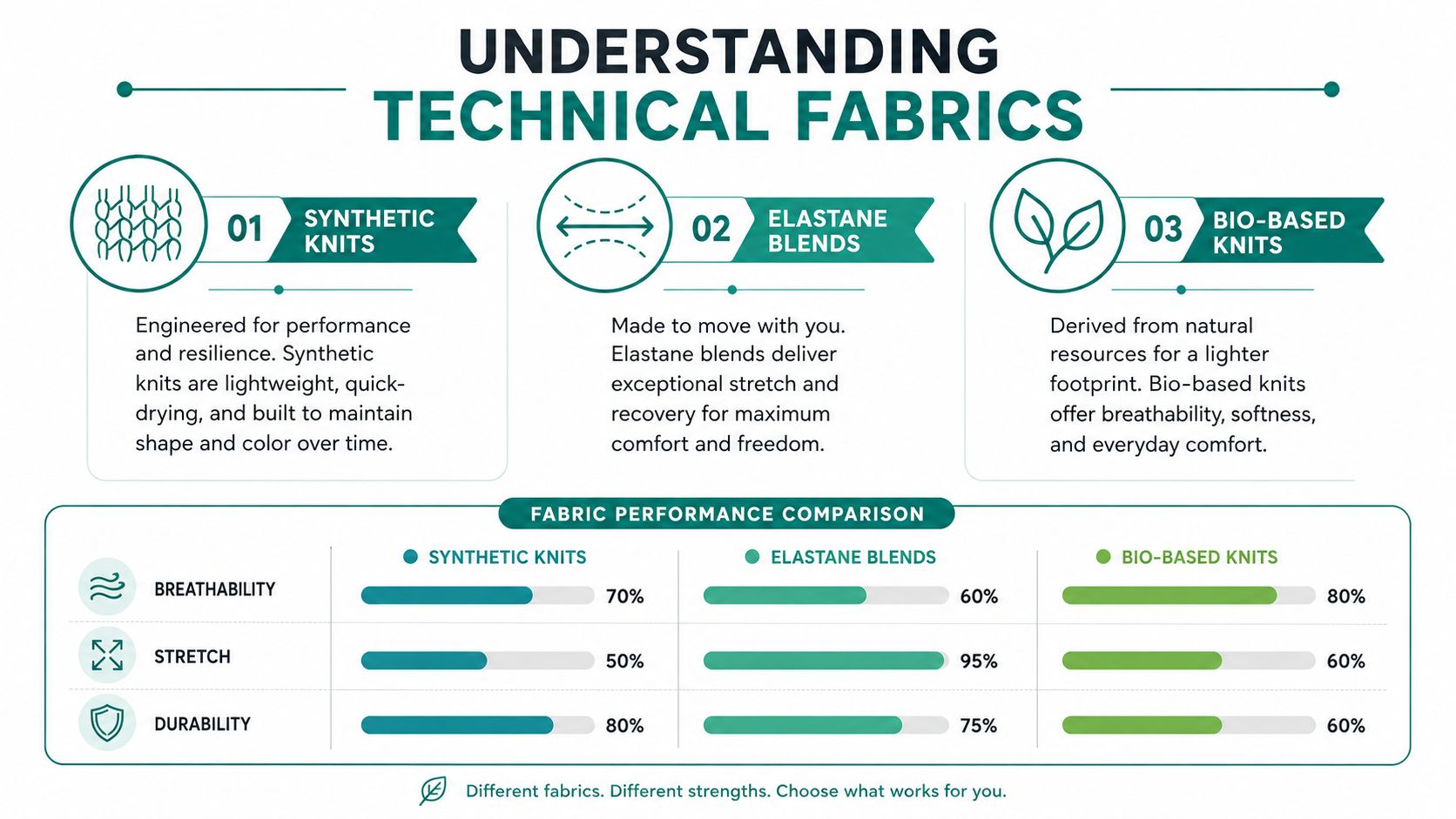
Synthetic knits, elastane blends, and bio-based knits
Most women's sportswear still relies heavily on synthetic and conventional materials, which accounted for 85.25% of revenue in one market report Market.us. That usually means polyester, nylon, or blends built around those fibers. They're popular because they can be made light, durable, and quick to dry.
Elastane is the stretch helper. By itself it's not usually the whole fabric, it's the ingredient that lets leggings snap back instead of sagging out like an old elastic hair tie. Bio-based knits are the newer cousin in the group, often discussed for their material story as much as for their feel. They can be appealing, but the label alone doesn't tell you everything about airflow or support.
Here's the easiest analogy: a knit is like either a chain-link fence or a tight basket weave. The fence opens up more, so it tends to breathe better. The tighter weave feels smoother and often looks more opaque, but it can trap more heat if the structure is too dense.
Why construction matters as much as the fiber name
A controlled study on moisture-management-treated cotton fabrics found statistically significant differences in air permeability, but no significant difference in heat and moisture transfer among the treatments themselves. The practical takeaway is straightforward, garment construction and knit structure can matter more than the finish alone when you're trying to stay comfortable Iris Publishers. In plain language, the way the fabric is built can matter just as much as the tag that says moisture-wicking.
Read the composition panel like a clue sheet. A higher elastane content usually means more hold and rebound. A denser knit often means better coverage. If the retailer lists GSM, or fabric weight, use it as a rough feel guide, lighter usually feels airier, heavier usually feels more substantial. None of those clues work alone, but together they help you predict whether a piece will feel like a second skin or like a light shield.
One more thing shoppers forget is what they carry in and out of the gym. A simple item like the Nylon Crossbody Bag For Women Fashion Portable Casual Underarm Bag Students Cross Body Bag makes sense here because its nylon main material, zipper closure, and moderate hardness fit the same practical mindset as a workout set, choose materials for function first, then style [product snapshot].
Support Levels That Match Your Workout
A sports bra changes how a session feels before the first rep starts. If the band rides up, the straps dig in, or the cup shape fights your movement, the whole outfit starts working against you.
Compression and encapsulation don't do the same job
Sports bras usually rely on two support strategies. Compression presses the bust closer to the chest to reduce movement, while encapsulation uses shaped cups or separate support zones to hold each breast more independently. A design review in Norris et al. found that encapsulation style, cup padding, adjustable underbands, and higher necklines improved breast-movement reduction in testing University of Portsmouth PDF. The takeaway is practical, construction details shape how much motion the bra controls.
Fit complaints show up in the details you feel right away. An international study on sports bra use found compression styles with racer backs, wide straps, and thick straps were favored in the US and UK, while shoulder-strap digging came up often as a problem ScienceDirect abstract. That is the sort of issue that can turn a promising bra into a distracting one after only a few minutes.
Use impact level as the first filter
Low-impact support suits yoga, stretching, and walking. Medium-impact support fits cycling, strength circuits, and general gym work. High-impact bras matter more for running, plyometrics, and anything with repeated bounce.
Fit check: the band should feel snug before the straps do. If the straps are doing all the work, the bra is not doing its job.
A simple test helps. Raise your arms, twist side to side, then do a shallow squat. No tissue should slip at the neckline or underarm, and the straps should stay flat instead of carving into your shoulders. If the bra shifts during those basic moves, sweat and repetition will make that irritation more obvious.
There is also a wash-and-wear angle that shoppers often miss. A bra that fits well but stretches out quickly stops supporting the way it should, so care matters as much as construction. Elastic recovery, cup shape, and the condition of the band all affect whether the garment behaves like a support piece or just another top in the drawer.
| Support Levels Matched to Workouts and Fit Checks | |||
|---|---|---|---|
| Support Level | Typical Workouts | Construction Type | Fit Check |
| Low-impact | Yoga, stretching, walking | Light compression, soft bands | No gaping when you bend and breathe |
| Medium-impact | Cycling, strength circuits, general training | Mixed compression, stable straps | Band stays put during arm raises |
| High-impact | Running, plyometrics, jumping drills | Encapsulation or engineered support | Bounce stays controlled in a squat test |
Training Looks Versus Running Looks
A lifting outfit and a running outfit can share the same body, but they shouldn't share every detail. The reason is simple, the body asks for different things when it's bracing under a bar versus repeating impact down a road.
Where the two outfits overlap
Both outfits benefit from quick-dry knits and flat seams. No one wants a side seam rubbing under a bra strap or a damp shirt clinging halfway through the session. That overlap is why many women keep a few staple pieces that work across formats.
The differences show up fast once movement changes. A lifting set can lean into a slightly more compressive tank and a bottom that stays opaque when you hinge. A running set usually needs lighter top layers, more heat shedding, and details that help the outfit stay visible and stable outside.
What changes first
Bottoms are the clearest split. Training shorts or leggings often prioritize waist anchoring and squat coverage. Running bottoms are more likely to focus on stride comfort, airflow, and less bulk. Tops follow the same logic, a lifting top can afford to be a little denser, while a run top usually works harder to move heat away from the skin.
Reflective accents belong more naturally outdoors. Bold prints are fine in the gym, where lighting is controlled and visibility is less of a factor. The running version often needs a more careful balance between function and safety.
| Training Outfit vs Running Outfit: What Changes and What Stays | ||
|---|---|---|
| Feature | Training Look | Running Look |
| Bottom cut | More focus on squat coverage and waist hold | More focus on stride freedom and heat release |
| Top weight | Slightly compressive or structured | Ultralight and breathable |
| Color strategy | Prints and darker tones work well indoors | Visibility details matter more outdoors |
| Layering | Often a single set is enough | A light outer layer can help before warm-up |
| Priorities that stay | Flatlock seams, quick-dry feel, stable fit | Flatlock seams, quick-dry feel, stable fit |
The simplest rule is this. If the session has repeated vertical impact, the outfit has to shed heat and stay put. If it has deep hip hinges, the outfit has to stay opaque and anchored at the waist.
Building a Complete Set From the Ground Up
A good try-on starts from the bottom and moves upward. That sounds obvious, but most fit problems show up only after the whole outfit is on, not when a single piece is hanging on a hook.
The first clue is the leggings. Pull them on and check where the waistband sits when you squat. If it rolls or slides below your comfort zone, it'll bother you all session. If the fabric grips the skin with a smooth, steady feel, you're probably looking at a knit that's doing more than just looking polished.
A seamless set changes the feel of the whole outfit
Seamless construction is useful because it reduces the number of stitched join points that can rub. In a knit-first set, the fabric itself does more of the design work, stretch zones, ventilation zones, and color blocking can all come out of the same tube of yarn rather than a patchwork of sewn panels. That's why pieces with this construction often feel more like one continuous shell than separate parts.
The bra comes next. Test the strap width under movement, not just standing still. If the straps feel fine with your arms down but start pressing once you lift overhead, that's a warning. The top matters too, especially hem length, because a short hem can creep up every time your hands go above your head.
Good try-on habit: move before you decide. A set that looks perfect in the mirror can fail the moment you reach, hinge, or twist.
The last thing people notice is finishing. A bonded cuff feels smooth and low-profile. A stitched hem feels a little more familiar, sometimes a little more obvious against the skin. Neither is automatically better, but the feel tells you a lot about how the piece was built to behave.
Caring for Your Gear So It Performs Longer
The fastest way to ruin good sportswear is to treat it like regular cotton. Technical fabric has memory, but heat, residue, and rough washing can erase that memory over time.
A routine that protects stretch and color
Start with a quick rinse or wash soon after sweaty wear, ideally within a day. That keeps sweat salts and body oils from sitting in the fibers. Then wash on cold with a mesh bag and a detergent made for sport gear, especially if the piece relies on moisture movement.
Skip fabric softener. It leaves a coating that can block the fabric's sweat channels, which is the opposite of what you want in activewear. Air-dry flat, away from direct sun, because heat and ultraviolet exposure are rough on both color and elastane.
Heat doesn't just dry the garment faster, it breaks down the elastic memory you're paying for.
Three habits cause the most trouble. A hot dryer cycle cooks stretch. Leaving damp gear in a gym bag invites odor and makes the fibers work harder later. Washing everything together, regardless of weight, can beat up lightweight tops with heavier zippers, denim, or rough fabrics.
A simple wear-and-replace cue is better than guessing by calendar age. If the waistband loosens, the bra band rides up, or the fabric stops bouncing back after washing, the garment has started to fatigue. That's usually the moment to retire it from heavy training and keep it for lighter use.
Your Simple Decision Checklist Before You Buy
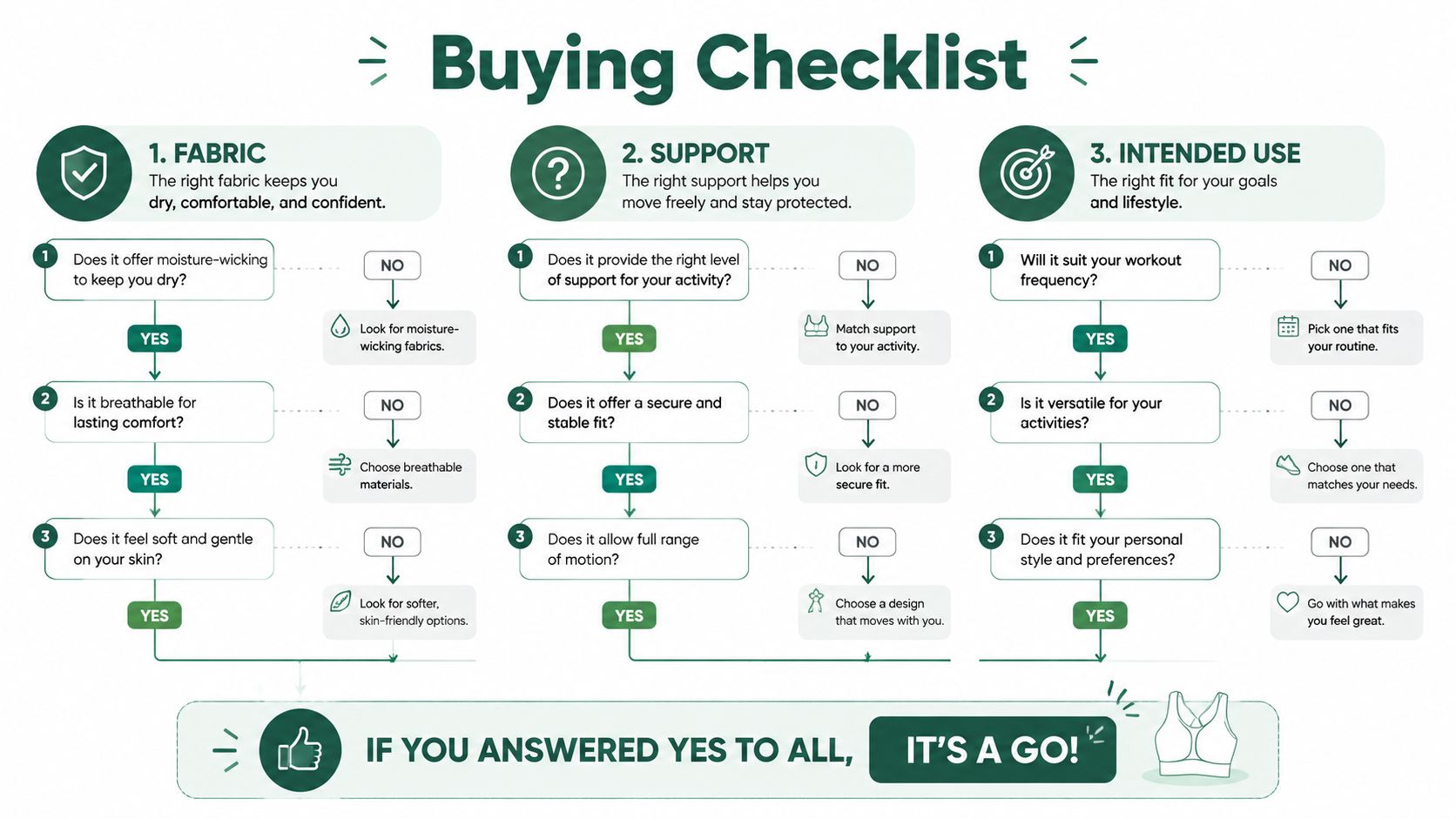
The smartest shopping move is to reduce the whole decision to three checks. Fabric, support, and intended use. If all three line up, the outfit has a much better chance of becoming a real favorite instead of a regret purchase.
Ask these questions before checkout
- Fabric: does the knit construction match how much you'll sweat, and does it feel like it can breathe where you need it to?
- Support: does the bra construction match the workout's impact, or are you hoping a pretty strap layout will do the job?
- Intended use: are you buying one set for everything, or does your training routine call for separate running and training pieces?
Those questions are easier to answer if you do a quick in-home test sequence. Read the care label first, because it tells you whether the set can survive your routine. Stretch the fabric and let it recover, because recovery tells you more than a flat-lay photo ever will. Check seam placement in a mirror, especially under the arms, across the waistband, and along the bra band.
Then ask one final question. Will this set still behave after several cold washes, or is it only impressive on day one?
If you want pieces that make those choices easier, Mode carries women's ready-to-wear, including sports and yoga sets, and its site also offers size guidance, FAQ support, and care information. Take one favorite legging or sports bra, compare it against these checks tonight, then visit Mode to see whether a set there matches the way you train.
Built with the Outrank app