

You're standing in front of the mirror with the gown sorted, the shoes chosen, the jewelry half-set on the dresser, and the watch still feels like the one detail that can ruin the whole look. That's where most women go wrong with a montre femme élégante. They buy the watch that looks expensive in a product shot, then discover at the gala that it sits too wide, fights the cuff, or competes with the rest of the outfit.
The right dress watch doesn't just tell time. It finishes the wrist the way a clean hem finishes a dress. And for formal wear, fit matters more than logo, trend, or case diameter alone.
Table of Contents
- Why Most Women Choose the Wrong Dress Watch
- Defining True Elegance in Women's Watches
- The Hidden Fit Variables That Matter Most
- Materials and Bracelets That Elevate Your Look
- Pairing Your Watch with Formal Outfits and Jewelry
- Your Complete Elegant Watch Selection Framework
Why Most Women Choose the Wrong Dress Watch
A gala look can be nearly finished, then the watch ruins the line. A polished dial, a bright bracelet, and a familiar name all look convincing in a product photo, but under satin, silk, or a sharp blazer, the wrong watch reads louder than the outfit.
Buyers fixate on case diameter and ignore how the watch sits. For an elegant women's watch, lug-to-lug distance usually matters more, because it decides whether the watch stays within the wrist's flat width or spills past it. Exact strap or bracelet fit matters too, as noted earlier in the Authentic Wrist watch sizing guide.
Two watches can share the same diameter and wear completely differently. One settles close and intentional, the other looks borrowed from a larger model. The same failure shows up when the bracelet is too rigid, too thick, or visually detached from the case.
A dress watch should stay quiet until the wrist is meant to be noticed.
Formalwear exposes every fitting mistake. A low-cut evening dress needs restraint, while a blazer sleeve needs a slim profile that will not catch or bunch. A watch chosen for display-case appeal instead of real wrist fit makes the whole look feel careless.
The deeper mistake is category confusion. A watch can be pretty and still fail at a wedding, gala, or cocktail party if it clashes with jewelry, overwhelms a narrow wrist, or adds too much visual noise. Elegance is about removing the wrong thing.
Defining True Elegance in Women's Watches
True elegance in a women's watch is restraint with intent. The watch should look composed, never busy for the sake of decoration. In formal settings, a clean dial, controlled proportions, and disciplined finishing beat clutter every time.
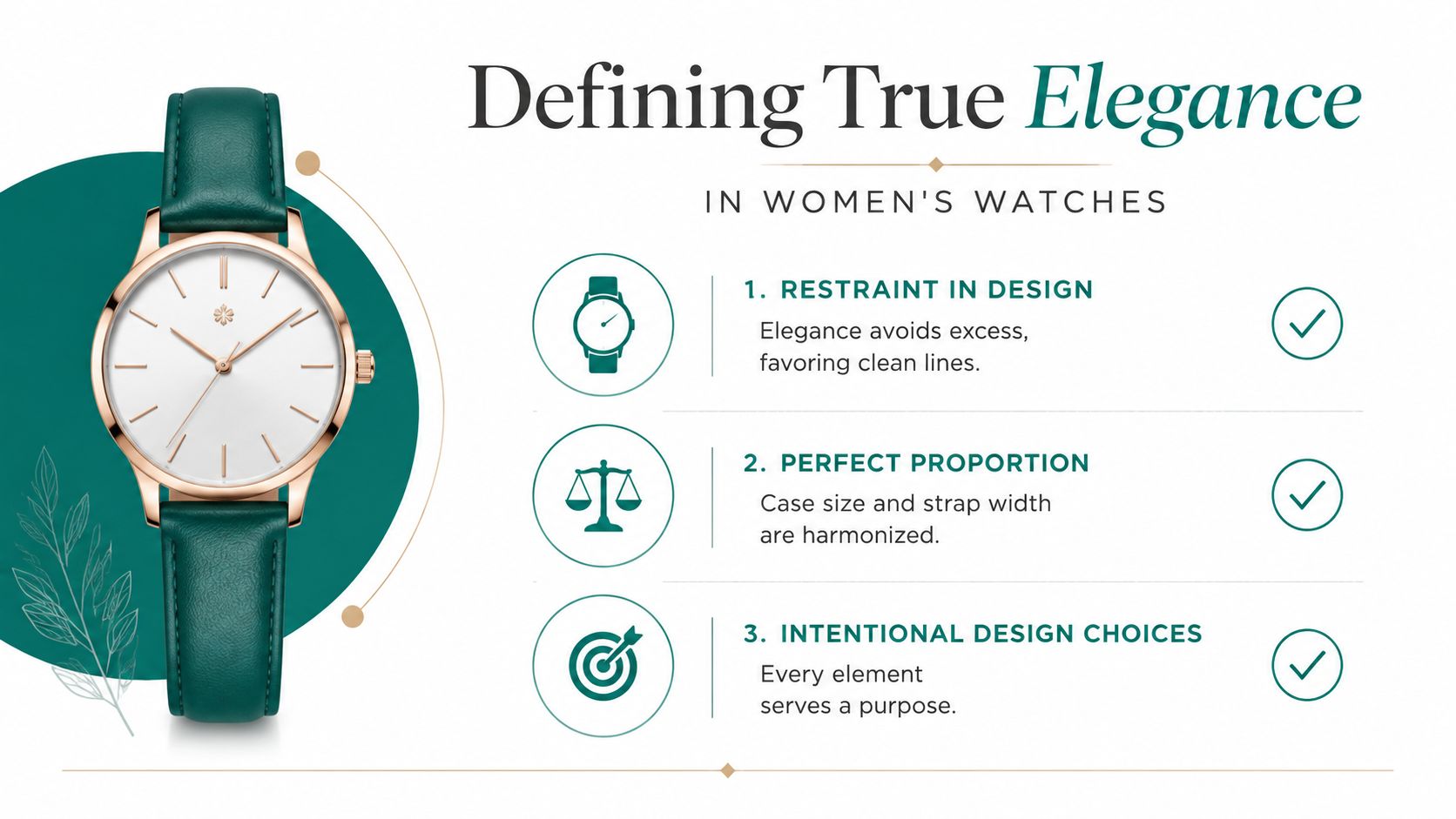
Start with the dial, not the sparkle
A minimalist dial with clean indices is the safest choice for a gala or ceremony. It reads refined because it leaves room for the rest of the outfit to speak. Heavy decoration, crowded subdials, or too many ornamental elements make the wrist feel busy, especially under formal lighting.
Case shape matters just as much. Round cases feel classic, rectangular cases feel sharper and more architectural, and tonneau shapes sit between the two. The right shape frames the wrist cleanly instead of competing with it.
Dial color should support the outfit, not dominate it. White and champagne are the easiest choices for versatility. Deep navy works when the look is deliberate and polished, especially with darker eveningwear. Bright or novelty colors can work in other settings, but they are a weaker choice for formal coordination.
Pay attention to thickness and finishing
Case thickness changes how a watch behaves under clothing. A slimmer profile slides under a cuff more gracefully and looks more deliberate with fitted pieces. A thicker case can still work, but it starts to read more casual or sporty unless every other detail is tightly controlled.
Movement type matters less than buyers think. Quartz and mechanical both have their place. For pure elegance, the visual language of the watch matters more than the movement inside. If the case, dial, and bracelet are proportioned well, the watch looks right regardless of what powers it.
The market for formal dressing supports that demand. The global women formal wear market reached about USD 205.83 billion in 2025 and is projected to rise to nearly USD 287.71 billion by 2032, with a 4.9% CAGR market estimate. That scale explains why elegant occasion pieces keep evolving, because formal dressing keeps rewarding refinement.
A strict evening watch should look like a finishing tool, not a loud centerpiece. That is the standard to use.
The Hidden Fit Variables That Matter Most
Lug-to-lug and wrist shape decide the fit
Case diameter gets attention, but it does not decide how a dress watch wears. Long, straight lugs push the watch past the flat part of the wrist and make a modest case look heavier than it is. Fit guidance for women's watches commonly points to lug widths around 12 to 18 mm and lug-to-lug lengths roughly 36 to 46 mm in women's and unisex pieces watch sizing guide.
Wrist shape changes the result. A flatter wrist can carry a broader watch with less strain on the eye, while a rounder wrist usually needs shorter, more curved lugs. The same model can look composed on one woman and awkward on another.
A watch looks larger when the ends overhang the wrist.
Bracelet integration matters just as much. A bracelet that flows cleanly from the case keeps the watch looking deliberate. A bracelet that drops too abruptly or sits stiffly can make even a refined dial feel clumsy. Strap length, watch shape, and wrist circumference work together, so one measurement never gives you the full answer strap sizing guidance.
Use measurements that predict elegance
Two watches can share the same diameter and wear very differently. Long lugs, a thick case, or a rigid bracelet make the watch feel larger on the wrist. Shorter, curved lugs and a balanced bracelet profile keep the same nominal size looking cleaner and more elegant.
| Measurement | Why It Matters | Ideal Range for Elegant Fit |
|---|---|---|
| Case diameter | Gives a rough size reference, but not the full picture | Moderate, based on wrist and lug design |
| Lug-to-lug distance | Decides whether the watch overhangs the wrist | A few millimeters under wrist width |
| Case thickness | Determines sleeve clearance and visual bulk | Slim enough to sit under formal cuffs |
| Lug width | Controls strap or bracelet compatibility | Must match the strap exactly |
| Bracelet integration | Affects comfort and silhouette | Smooth transition from case to bracelet |
Keep your focus on the full geometry, not the headline number. If the lugs stretch too far, if the case sits too tall, or if the bracelet looks bolted on, the watch will distract from the outfit instead of finishing it. For formal dressing, that mistake shows immediately.
Materials and Bracelets That Elevate Your Look
Material choice changes the mood of the entire watch. Some finishes look expensive but tire quickly in daily use. Others look quieter at first and become the smarter choice once you start pairing the watch with actual clothes and jewelry.
| Material / Bracelet Type | Formality Level | Durability | Comfort | Best Occasion |
|---|---|---|---|---|
| Stainless steel | High | Strong | Cool and steady | Office, dinner, formal daywear |
| PVD gold plating | High | Good for occasional wear, less ideal for rough daily use | Comfortable | Gala, wedding, dressy evenings |
| Solid gold | Very high | Excellent finish retention | Heavier on the wrist | Black-tie, heirloom dressing |
| Ceramic | Modern formal | Scratch-resistant look, but more fragile to impact | Smooth | Contemporary evening events |
| Leather strap | High to very high | Depends on leather type | Soft and light | Ceremonies, elegant dinners |
| Milanese mesh | High | Durable | Flexible and breathable | Office to evening transitions |
| Link bracelet | High | Strong | Adjustable and structured | Formal wear, tailored outfits |
Steel is the easiest choice if you want one watch that can move from office to dinner without thinking about it. It's polished, versatile, and doesn't try too hard. PVD gold plating works well for formal looks, but it's better on a watch you rotate than on a piece you wear hard every day. Solid gold looks and feels more luxurious, but the extra weight changes the character of the watch immediately.
Leather is where formality gets sharper. Alligator feels the most ceremonial. Calfskin is more restrained and easier to wear often. Satin-lined straps are practical when comfort matters and the event is long. Milanese mesh gives you a sleeker, more modern finish, and it works especially well with fitted dresses and minimalist jewelry.
The H098 Free Size Muslim Dress Pray Khimar Kaftan Burqa Abaya Robe Hijab Middle East Clothing is a loose, knitted polyester abaya-style garment with diamond decoration, thin thickness, and an all-season casual profile. That kind of coverage makes bracelet and cuff proportion even more important, because a watch can't rely on exposed skin to create balance.
For a black-tie gala, I'd choose steel, mesh, or a refined leather strap before anything oversized or heavily jeweled. For a daytime garden wedding, a softer leather or light metal bracelet feels cleaner. For a corporate boardroom meeting, keep the finish restrained and the bracelet structure neat.
Pairing Your Watch with Formal Outfits and Jewelry
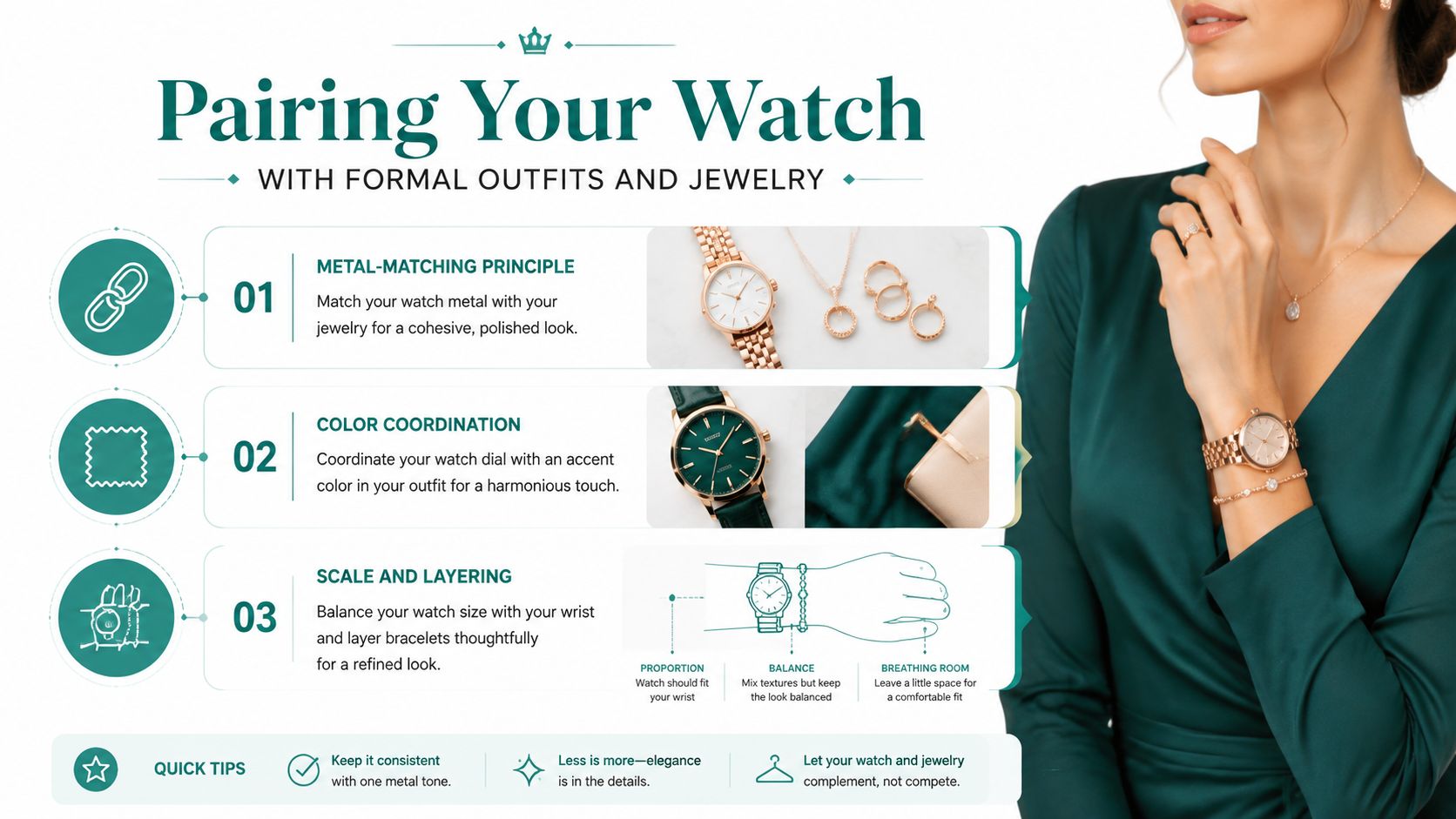
The watch should support the outfit hierarchy, not fight for attention. If the dress already has drama, the watch should be calm. If the dress is minimal, the watch can carry a little more presence, but only at the wrist.
Match metal tone before you match anything else
Rose gold belongs with warm-toned accessories, white metals with cool-toned pieces. That's the cleanest route to visual harmony. You can mix metals, but only when the rest of the outfit is disciplined enough to absorb the contrast.
A strapless gown is where bracelet watches work best. The wrist is visible, so a slim bracelet watch can sit beside a bangle stack without looking crowded. A long-sleeved blazer or fitted jacket asks for a lower-profile case that slides under the cuff without snagging.
The wrist is a focal point, so treat it like one.
The same logic applies to necklaces and earrings. If the watch is ornate, keep the neckline and earrings simpler. If the watch is minimalist, you can let the rest of the jewelry carry more shape or texture.
Build a jewelry hierarchy, not a pileup
The watch should anchor the wrist. That means resisting the urge to stack it with every bracelet you own. One or two supporting pieces are enough if the watch already has strong visual character. Once the wrist starts competing with the neckline, the whole look loses precision.
A diamond-bezel tank watch pairs neatly with a simple pearl drop earring because both pieces stay in their lane. A minimalist steel dress watch can handle sculptural silver cuffs if the dress itself stays clean. A bolder bracelet watch works only when the rest of the outfit is quieter.
The included styling video can be useful if you want to see how proportion shifts across different outfit types.
A practical rule I use with clients is simple. If the dress has texture, embellishment, or a strong neckline, choose a watch that behaves like a supporting actor. If the dress is pared back, the watch can be the sharpest accessory, but it still has to respect the rest of the metal tone.
Your Complete Elegant Watch Selection Framework
Filter the watch in five decisions
Start with the occasion. A gala, wedding, and boardroom meeting all ask for different degrees of shine and structure. If the watch can't do the job across your main use case, it's the wrong watch.
Next, measure your wrist and check the shape. Flat wrist, round wrist, narrow wrist, broad wrist, each one changes the way lugs and bracelets behave. If you know the wrist shape, you can reject half the options before you ever try them on.
Then choose the material based on wear pattern. If you're rough on accessories, avoid fragile finishes for an all-day piece. If the watch is for occasional formal use, you can prioritize finish and elegance over hard-wearing utility.
After that, choose the bracelet or strap to match the outfit you wear. Satin gowns, sharp blazers, and embellished dresses each ask for a different visual weight on the wrist. A good watch should make your wardrobe easier, not more complicated.
Finally, decide whether you want quartz convenience or mechanical character. Quartz is the no-fuss answer. Mechanical makes sense if you care about the feel of horology itself. Neither is automatically more elegant.
| Decision | Ask Yourself | Eliminate If |
|---|---|---|
| Occasion | Will this work at my main events? | It feels too casual or too loud |
| Fit | Does it stay inside my wrist width? | Lugs overhang the wrist |
| Material | Will I wear this often or only for events? | The finish won't suit the use |
| Bracelet or strap | Does it match my outfit structure? | It clashes with sleeves or jewelry |
| Movement | Do I want convenience or horological feel? | It adds hassle you don't want |
Watch for the red flags
A thick case that catches on sleeves is a bad purchase. A trend-driven dial color that doesn't work with your wardrobe is another mistake. A link bracelet with a weak clasp feels cheap the moment you use it.
Mode's site is a useful reference point if you're comparing the watch to the rest of the evening look, because it also carries formalwear and accessories, including a satin evening dress with an open back, halter neckline, and flowing cape, plus a square watch and heart bracelet set on the storefront Mode. That matters because the best watch choice is never isolated from the outfit.
If you want a watch that earns its place beside a formal dress, shop the wrist first and the logo second. Visit Mode to compare elegant occasionwear and accessories together, then choose the watch that fits your wrist shape, your sleeve line, and your jewelry without forcing the rest of the look to adapt around it.
Produced via the Outrank app